
It’s the most common question we get asked – what is the cost of building a house in New Zealand? Most people say – how long is a piece of string? However, we’re not here to give some vague answer, we want to create clarity around the topic.
(Note: this article has been updated in March 2026 to reflect current pricing we’ve been seeing from builders. Prices are assumed to include GST.)
The Minimum Cost of Building a House in NZ
Budget on $4000 per square metre as an absolute minimum. No, unfortunately you can’t build a 300m2 home for $450,000 like you can in Australia!
To give some context, some of the recent prices we’ve seen for fairly ‘normal homes’ we’ve designed have been in the range of $4000-$5500 per square metre.
We’ve got a client currently getting build pricing at $3500/m2. It is in Northland, on a flat site, with a cost effective builder, 2.55m stud, large living, fairly standard specification. However, that allows for no earthworks, or any variations, or landscaping, which is why we say budget on $4000/m2.
But remember, it’s super easy to end up above $4500/m2 as soon as the site is anything steeper than flat, retaining walls get introduced and you start wanting to customise (as we all do) the design.
Note: A Square metre (m2) is a 1m by 1m square box. The area includes wall framing, so is measured to the edge of the concrete slab or floor. It would generally excludes eaves, decks and driveways. For two storey homes add the downstairs m2 to the upstairs m2.
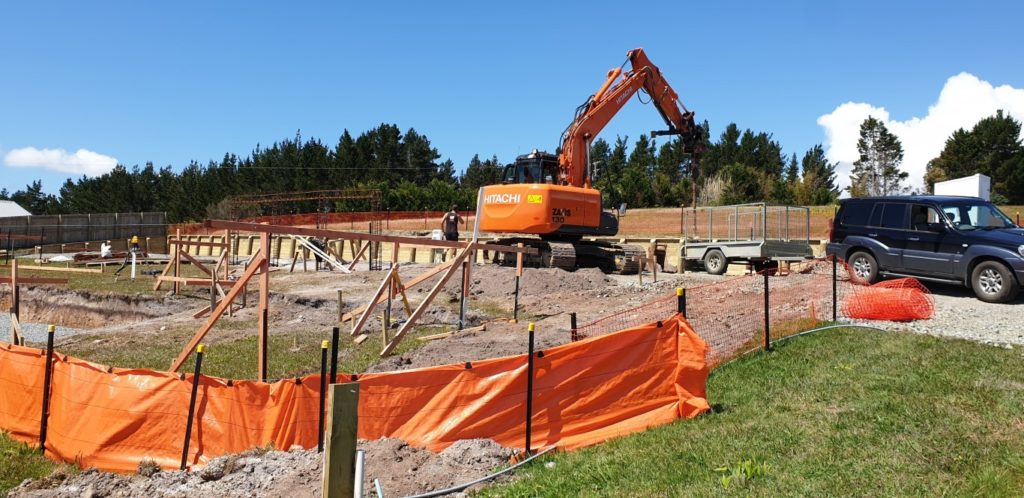
Where do the figures above start and stop?
Free 6 Part Email Series:
'Designing Your Home'
What Pushes Cost Up?
There’s a few immediate giveaways that you’re going to creep towards the $4500/m2 region:
– Elevated sites, exposed to the wind
– Steep (or even not so steep) sites that require retaining walls
– Unsuitable ground requiring engineering design
– Large square metres of glass (requiring steel portals)
– Open expanses of living areas (requiring engineering due to lack of walls to brace)
– Cantilevered decks, roofs, floors
– Expensive cladding (like cedar) & roofing (tray roofing)
– Difficult site access
– Any build methods that are time consuming
With all our home designs we ‘de-engineer’ them as much as possible to keep within your budget. There’s no point designing a home you can’t afford! Budget costing throughout the design process helps budget accuracy.
You may find our ‘10 Ways to Make Your House Design More Affordable‘ page helpful.
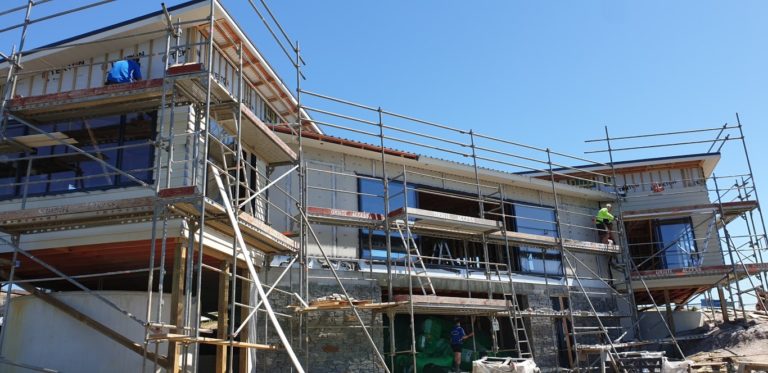
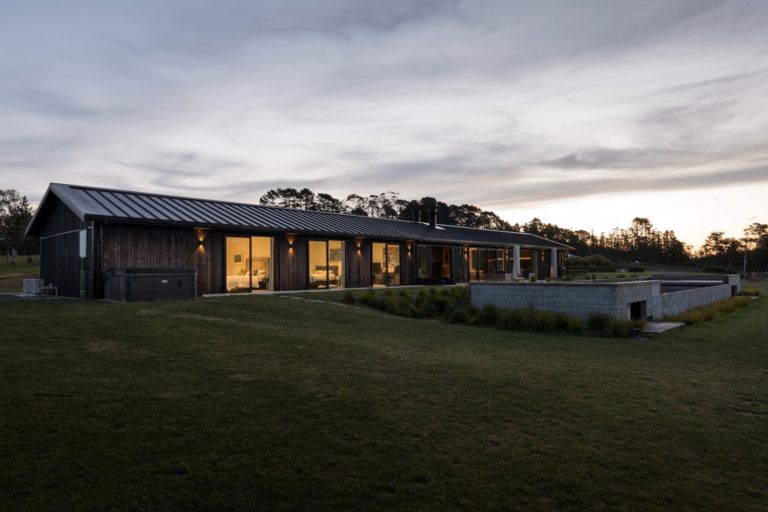
But why is it so expensive to build in NZ?
You can argue till you’re black and blue as to why the building costs are so more expensive in New Zealand than Australia, but one thing you’re not going to change – the building costs.
Material costs had huge inflation through Covid, 2021 and 2022. Although dwelling numbers being built have been decreasing we haven’t seen material costs decreasing a lot. The point is, there’s no better time to build than now.
Have a look at our two below blog posts which will dive deeper into this topic:
– Why Is Building In NZ So Expensive?
– Building: Design & Consenting Costs
Kitset Homes are Cheap, Aren’t They?
Yes, the ‘structure’ is extremely affordable. It arrives flat-packed on a truck, ready to be erected, or often prebuilt in a yard. But slow down a second, factor in earthworks (40k), service connections (10k), septic system (20k), decks, labour, appliances, fitout, bathroom fittings…the list goes on, and the cheap $120,000 home has suddenly become a $200,000 home, if not more.
Any company that starts promising homes for unusually low prices – take a good hard look at what is and isn’t included. Often low prices are used as a marketing tactic and the extra costs are not transparently displayed at the beginning.
We’ve Given You A Starting Point
Anyone associated with the building industry could challenge our above stated figures, for sure. It’s very easy to build a house at $7000/m2, depending on the size, location and specification. In fact some Architects won’t accept you as a client unless you’ve got over $8000/m2 to spend on your home.
Lastly – If you’d like some expert advice on exactly how and where you should spend your budget on your new home, contact the Arcline Team to start your journey to your new home today.